
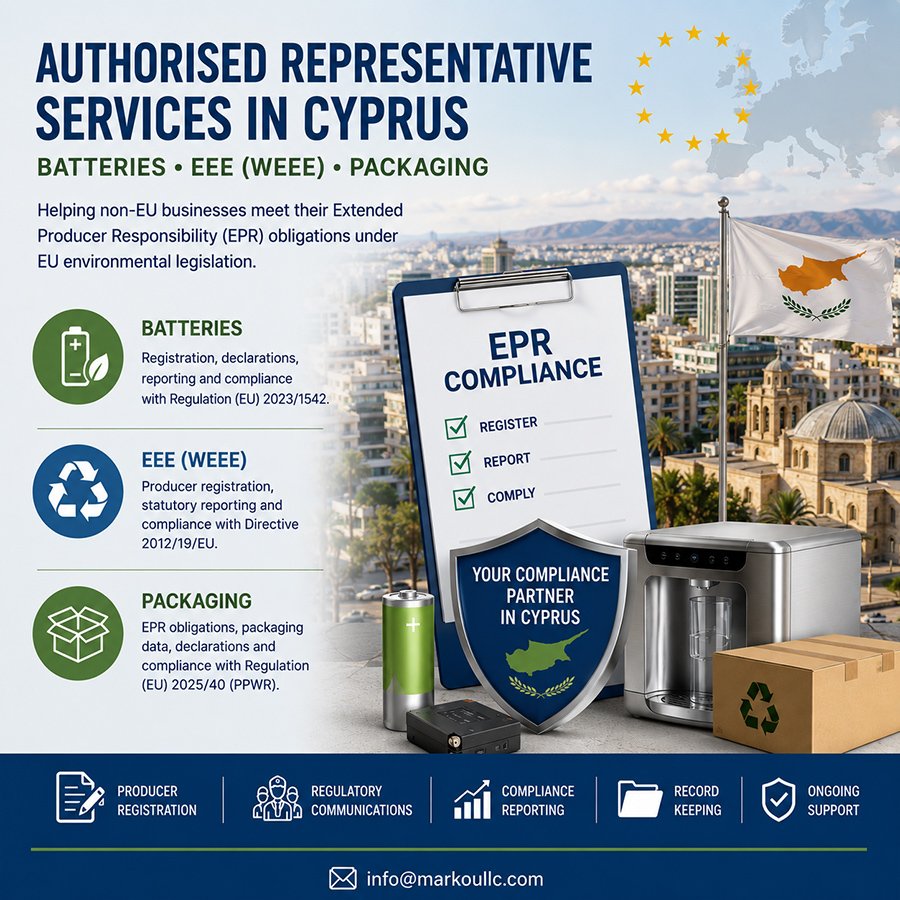
Extended Producer Responsibility (EPR) and Authorised Representatives in Cyprus – Batteries, EEE and Packaging
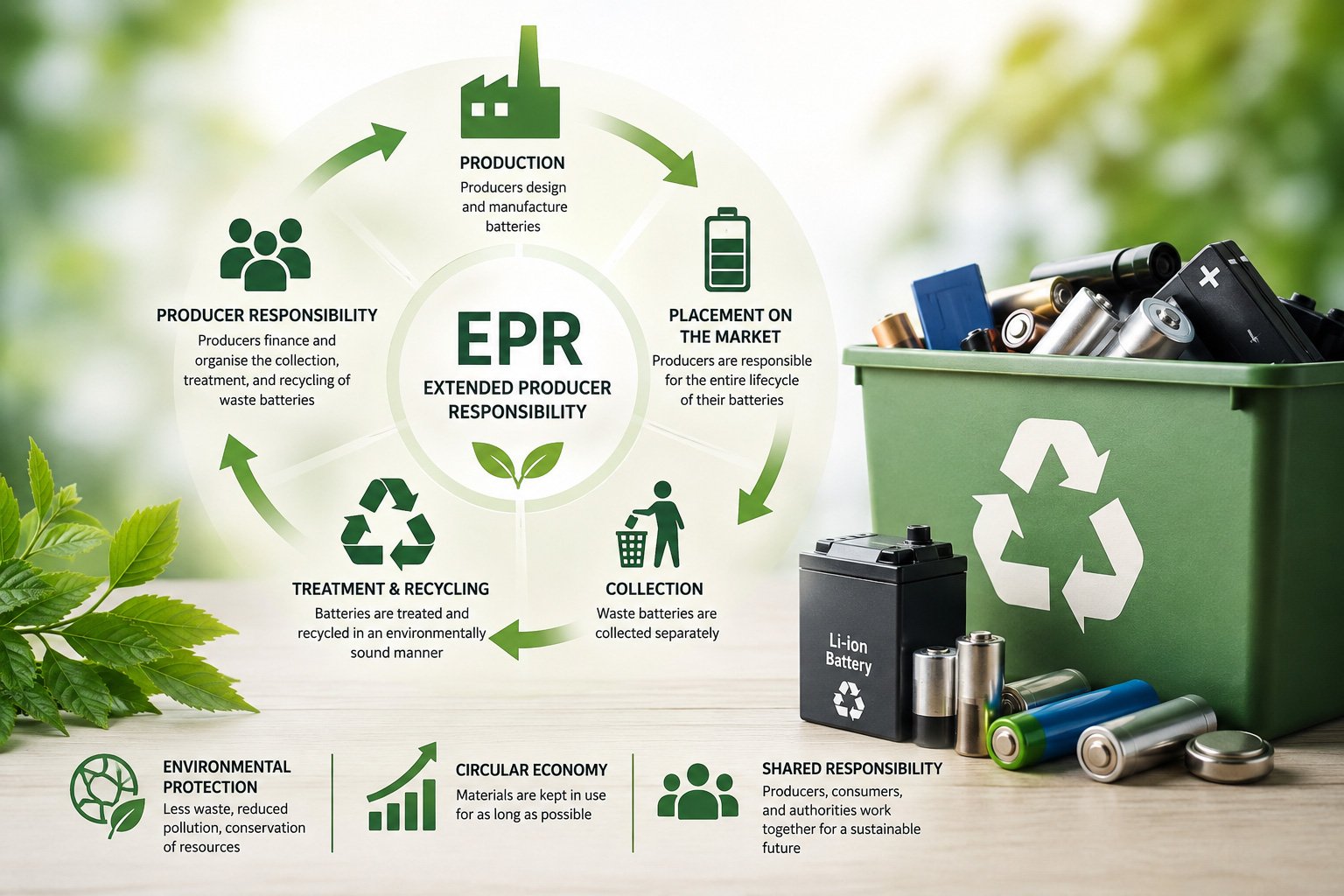
Businesses placing batteries, electrical and electronic equipment (EEE), or packaged products on the market in the European Union are subject to Extended Producer Responsibility (EPR) obligations under EU environmental legislation. Where the applicable legislation requires, producers that are not established in the Member State in which they place products on the market must appoint an Authorised Representative to fulfil specified statutory obligations on their behalf.
An Authorised Representative is appointed by written mandate and acts within the scope of the authority conferred by the producer and the applicable legislation. The precise duties vary depending on the relevant legal framework.
Batteries
Regulation (EU) 2023/1542 concerning batteries and waste batteries establishes a harmonised legal framework governing the placing on the market of batteries and the management of waste batteries throughout their life cycle. The Regulation introduces Extended Producer Responsibility obligations designed to ensure the proper collection, treatment and recycling of waste batteries.
The Regulation provides for the appointment of an Authorised Representative in the circumstances specified therein, enabling producers that are not established in the relevant Member State to fulfil their statutory producer obligations through a locally established representative acting under a written mandate.
These obligations include:
- registration with the relevant producer register;
- communication with the competent authorities;
- submission of statutory declarations and reports;
- maintaining records required by law;
Briefly, the obligation applies when the producer sells batteries, including those incorporated in appliances, light means of transport or other vehicles, by means of distance contracts directly to end-users, whether or not they are private households, in a Member State, and is established in another Member State or in a third country (Article 56(3)). Currently, Cyprus does not seem to have been applying this requirement of the Regulation despite its mandatory nature. More specifically, Cyprus’s producer registration form has been updated to reflect Regulation (EU) 2023/1542 and the revised definition of “producer”, but it does not yet contain any mechanism for identifying or registering an authorised representative under Article 56(3). As there is no evidence of a coordinated EU practice postponing Article 56(3) and other Member States have expressly operationalised the requirement that foreign producers engaging in battery distance selling must appoint an authorised representative for extended producer responsibility, it would seem that Cyprus is currently in an administrative transitional stage. It is worth nothing that the requirement stems from a Regulation and is therefore directly applicable to Cyprus, without it having to introduce any national legislation for that purpose.
Electrical and Electronic Equipment (WEEE)
Directive 2012/19/EU on Waste Electrical and Electronic Equipment (WEEE) establishes measures to prevent the generation of WEEE and to promote its reuse, recycling and recovery through the principle of Extended Producer Responsibility.
Article 17 of Directive 2012/19/EU requires a producer that supplies from a distance (distance selling) electrical and electronic equipment in a Member State in which it is not established to appoint an Authorised Representative established in that Member State to fulfil the producer’s obligations under the Directive.
Within the scope of the written mandate, the Authorised Representative may undertake statutory compliance functions including:
- registration with the national producer register;
- communication with the competent authorities;
- submission of mandatory reports and information;
- maintenance of legally required records; and
- performance of the producer obligations entrusted to it under the written mandate.
Interestingly, under Article 17(2) of Directive 2012/19/EU (the WEEE Directive), a producer established in another Member State or a third country that sells electrical and electronic equipment (EEE) by means of distance communication directly to users in a Member State is required to appoint an authorised representative in that Member State. However, the position in Cyprus is less straightforward. The Directive has initially been transposed through the Waste (Waste Electrical and Electronic Equipment) Regulations of 2015, as amended, but Regulation 22 did not appear to impose the reciprocal obligation on foreign distance sellers into Cyprus. Instead, it expressly permitted producers established in another Member State to appoint an authorised representative in Cyprus and required Cyprus-established producers selling by distance into another Member State to appoint an authorised representative there. There was an obvious gap and an inconsistency with the Directive. The transposing Regulations were amended in 2017 but the wording of the relevant Regulation still does not reflect Article 17 of the Directive, as it should.
Accordingly, while Article 17(2) of the WEEE Directive clearly states that such an obligation should exist, the current Cyprus implementing legislation and published administrative guidance do not expressly confirm it, leaving a degree of legal uncertainty as well as doubts regarding whether the Cyprus transposition is compatible with the EU Directive. Indeed, the official Cyprus WEEE producer registration form expressly contemplates authorised representatives and applies to foreign producers selling EEE by distance directly to users in Cyprus. However, both the form and its explanatory notes state that such producers may appoint an authorised representative in Cyprus by written mandate in accordance with Regulation 22(1), rather than providing that they must do so. This mirrors the permissive wording of Regulation 22 and contrasts with the mandatory wording of Article 17(2) of the WEEE Directive. What is definite is that according to general principles of EU law, if the issue arises, national authorities will have to interpret national law in with compliance with the Directive.
Packaging
Regulation (EU) 2025/40 on Packaging and Packaging Waste (PPWR) establishes harmonised rules on packaging and packaging waste across the European Union and strengthens the Extended Producer Responsibility framework applicable to packaging producers.
The Regulation distinguishes between an Authorised Representative appointed for product compliance purposes and an Authorised Representative for Extended Producer Responsibility.
Article 45 of Regulation (EU) 2025/40 provides for the appointment of an Authorised Representative for Extended Producer Responsibility in the circumstances specified by the Regulation. These refer to cross-border producers making packaging or packaged products available directly to end users in another Member State. Online marketplaces will also be covered when they act as sellers. Where Article 45 applies, the producer must appoint the Authorised Representative by written mandate to fulfil the producer’s EPR obligations in the Member State concerned.
Depending on the applicable legal requirements, the Authorised Representative’s responsibilities may include:
- registration with the relevant producer register;
- submission of packaging data and statutory declarations;
- communication with the competent authorities;
- maintaining records required by law;
- assisting with compliance relating to Extended Producer Responsibility obligations; and
- performing the obligations expressly entrusted to it under the written mandate and the applicable legislation.
The aforementioned obligations come into force on 12/8/2026 but there has not been any official announcement by the Department of Environment. It is important to note that similarly to the context of batteries, the particular requirement for packaging stems from EU Regulation; it is therefore directly applicable (as law) to Cyprus without the need of any implementing or transposition law at national level.
Pending important legislative developments
It should be noted that, on 10 December 2025, the European Commission adopted two legislative proposals as part of its Environmental Omnibus simplification package. Proposal COM(2025) 982 final would suspend until 1 January 2035 the application of Article 56(3) of Regulation (EU) 2023/1542 (Batteries Regulation) and Article 45(3) of Regulation (EU) 2025/40 (Packaging and Packaging Waste Regulation), while Proposal COM(2025) 983 final would suspend until the same date the application of Article 17(2) of Directive 2012/19/EU (WEEE Directive), together with certain corresponding authorised representative obligations under other EU waste legislation. The stated objective of the proposals is to reduce the administrative burden associated with the appointment of authorised representatives for cross-border extended producer responsibility obligations. In the case of the PPWR, however, Member States would continue to have the option of requiring producers established in third countries to appoint an authorised representative. At the time of writing, both proposals remain subject to the ordinary legislative procedure and have not yet been adopted. They must therefore be approved by both the European Parliament and the Council before becoming law. Although the proposals form part of the Commission’s simplification agenda and may therefore progress relatively quickly, the timing of their adoption cannot be predicted with certainty and the existing legal framework continues to apply unless and until the proposals are adopted.
Contact Us if you need more information
Our firm can assist businesses in complying with their statutory obligations under the applicable EU and Cypriot legal framework, including producer registration, regulatory communications, compliance reporting and ongoing support in fulfilling their Extended Producer Responsibility obligations. More generally, we can advise on matters to environmental-related obligations of businesses. You can contact us at info@markoullc.com.
